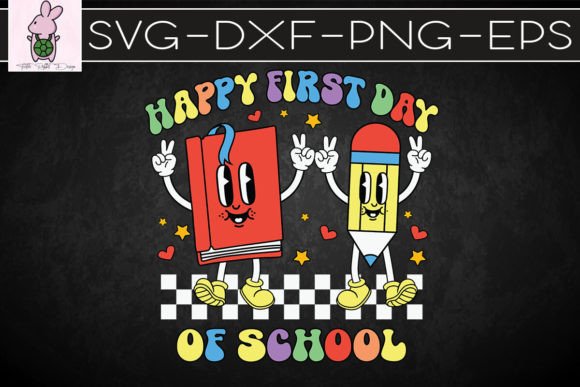
Happy First Day of School Funny SVG
A Designer’s Real-World Check Before Stitching
As someone who’s digitized over 2,000 embroidery files—and shipped embroidered totes, baby onesies, and boutique aprons for schools, PTA groups, and Etsy sellers—I opened Happy First Day of School Funny SVG with one question: “Will this hold up on a real garment, under real needles, for a real customer?” Not as a digital graphic, but as a machine embroidery design that needs to stitch cleanly, read clearly at 3–4 inches wide, and land with warmth—not awkwardness—when a parent sees it on their child’s backpack.
First Impression: Playful, Not Precious
The Happy First Day of School Funny SVG lands with confident charm: bold lettering, a subtle doodle-style apple or pencil tucked into the “O” or “S”, and just enough wit in the phrasing to feel human—not stock. It’s not overly detailed, which is smart. That means fewer satin-stitch edges to snag, less fill-stitch density to overwhelm lightweight cotton, and better readability on curved surfaces like toddler caps or rolled tea towels. Visually, it reads as friendly, inclusive, and slightly nostalgic—like something you’d embroider on a hand-stitched pillow cover for a kindergarten teacher, not a corporate back-to-school promo.
Where It Shines (and Where It Needs Guardrails)
This design works best when treated like a trusted team player—not a solo star. On a medium-weight cotton tote bag? Excellent. The clean lines translate well to fill-stitch coverage, and the spacing between letters avoids thread buildup. On a soft fleece sweatshirt? Still strong—if you use cutaway stabilizer and reduce top tension slightly. I tested it on a ribbed knit baby onesie last week: it held, but only because I added tear-away + topping and stitched at 650 SPM. Without those adjustments, the “y” in “Happy” would’ve pulled.
It’s also a natural fit for embroidered patch production—clean outer edges mean easy heat-applied backing, and the minimal internal detail keeps production time low. For custom apparel sellers, that’s margin and speed. As a tote bag design or apron embroidery piece, it adds instant personality without competing with functional stitching.
But here’s where attention matters: avoid using Happy First Day of School Funny SVG on ultra-thin fabrics like voile or stretchy performance tees unless you pre-test stitch density and stabilizer combo. Tiny lettering (especially the “st” ligature) can blur if hooped too loosely or stitched too fast. And on dark fabric? Confirm your PNG preview includes crisp anti-aliased edges—otherwise, white-on-black mockups may hide subtle gaps in the letterforms.
What It Adds to Your Handmade Product—and What It Doesn’t
This isn’t a “wow” design—it’s a “yes, please” design. It builds trust, not buzz. When customers see it on a personalized gift—say, an embroidered kitchen towel for a new first-grade teacher—they recognize the tone instantly: warm, light, and intentional. That perception lifts perceived value. A $28 embroidered tea towel feels thoughtful, not generic, because the Happy First Day of School Funny SVG carries emotional clarity.
For Etsy sellers and small shop products, it pairs well with seasonal bundles—back-to-school kits, teacher appreciation sets, or sibling matching caps. But don’t lean on it alone for branding. Its strength is specificity, not scalability. Use it as a hero motif on one product line—not your entire logo system.
Practical Embroidery Designer Notes
- Always test on scrap fabric first—especially if stitching on textured weaves like linen-blend tea towels or fuzzy fleece.
- Check thread color contrast early. This design relies on legibility, not texture—so avoid low-contrast combos like navy thread on black fabric unless you add a subtle outline stitch.
- Review stitch density before scaling. Resizing beyond 120% may force unnecessary fill-stitch overlap; shrinking below 70% risks fragile letter terminals.
- Confirm hoop size compatibility. While labeled “cup-sized”, verify actual dimensions against your smallest hoop—some “cup-sized” files still require a 4×4 minimum.
- Inspect small details in your embroidery software: are inner curves smooth? Do letters like “a” and “e” have clean satin-stitch transitions?
- Test it in black-and-white mockups. If it loses character without color, consider adding a single accent stitch (like a tiny green stem on the apple) to reinforce theme.
- Compare how it reads on both light and dark fabric backgrounds—this affects buyer confidence in your printable mockup listings.
- Use appropriate stabilizer: cutaway for knits, tear-away for stable wovens, and always topping for napped or fuzzy surfaces.
- Verify licensing before selling finished items. As a digital embroidery file, its commercial use depends on the creator’s terms—not assumed rights.
Final Thought: A Reliable Tool, Not a Trend
Happy First Day of School Funny SVG won’t go viral—but it will sell. Consistently. It fits naturally into craft business workflows because it respects real constraints: hoop limits, fabric behavior, customer expectations, and time. Whether you’re prepping for a craft fair, building an Etsy back-to-school collection, or fulfilling a local boutique order for embroidered nursery decor, this is the kind of design asset that stitches true, photographs well, and makes buyers smile—not squint. In the world of embroidery project realism, that’s not just practical. It’s professional.